One Thing Home
The Cup
Audio Version Coming Soon
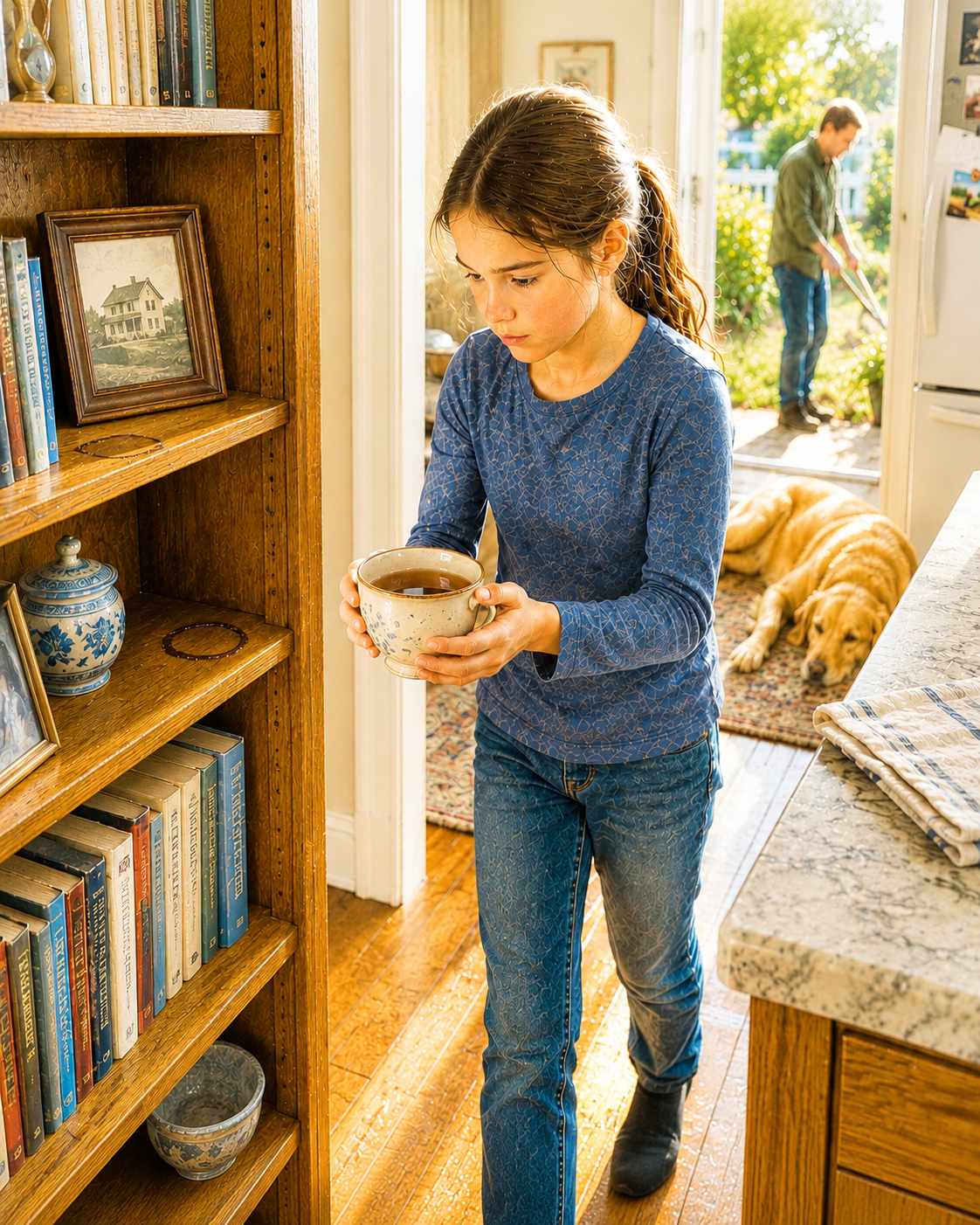
Anna’s father had left a cup of tea on the bookshelf, not in the kitchen and not on the table, but on the third shelf beside the photograph of the house when it was new. The tea was still warm, and Dad was outside, and the cup was full, and these were the conditions.
Anna looked at the cup without touching it. A ring had already formed on the shelf beneath it, dark and wet at the edges and dry at the center. The ring was already there, so that was not the problem. The problem was that the cup was full, and full cups move inside themselves.
She looked at the distance from the bookshelf to the kitchen counter, tracing the path past the lamp cord on the floor, through the doorway, and left at the refrigerator. A doorway was a different kind of hazard because doorways required turning, and turning with full cups required understanding what the liquid would do before it did it.
Anna stood still and thought about the tea, knowing that tea moves forward when you stop, moves back when you start, and moves to the outside when you turn. Starting and stopping were manageable, but turning was the problem.
Two-hand carry would provide maximum stability, but her hands would block the view of the liquid surface and force her to manage movement she could not see, while one-hand carry would allow full surface visibility but reduce control at the base.
Anna considered and chose two-hand carry because feeling the base mattered more than seeing the surface. “Watch the liquid, not the cup,” she said quietly.
She lifted the cup, and the tea moved immediately toward her, not spilling but adjusting. Anna stopped lifting and held the cup at counter height until the surface settled back to flat, and she waited until it was still.
She began moving. The lamp cord came first, low and almost nothing but still enough to matter, and Anna stepped over it slowly. The tea shifted forward with the lean of her body and then back as she straightened, and a small wave crossed the surface and returned smaller than it left.
The doorway came next, and she stopped before it. A left turn meant the tea would move right, which made the right side of the cup the danger side. Anna tilted her right thumb slightly upward, not much but enough to pre-angle the cup before the turn began.
She turned, and the tea went right, rising on that side until it stopped just below the rim before coming back down. Anna kept moving through the turn without pausing because pausing mid-turn was worse than completing it. She came out of the doorway straight, and the tea flattened again. “Through,” she said.
The kitchen counter was six steps ahead, and she took them slowly. The tea made small adjustments with each step, moving a little forward and a little back, then forward again, but it did not spill.
At the counter, Anna stopped, knowing that lowering was the last danger because stopping too fast would send the tea forward while stopping too slowly would give it time to build movement. She bent her knees instead of her arms so that the cup descended with her body and not just her hands, and the tea barely moved.
The cup touched the counter, and Anna held it there with both hands while the tea completed its last small motion, forward and back, then forward and back again, smaller each time until it became still.
She removed her hands. The tea had darkened slightly at the edges from cooling, and a thin line of liquid clung to the inside of the cup just below the rim where the last wave had reached. It was not a spill but evidence of movement.
Anna looked at it for a moment and said, “Surface settled.” Then she looked back at the bookshelf where the ring was still there, and she understood that part was not hers to fix.