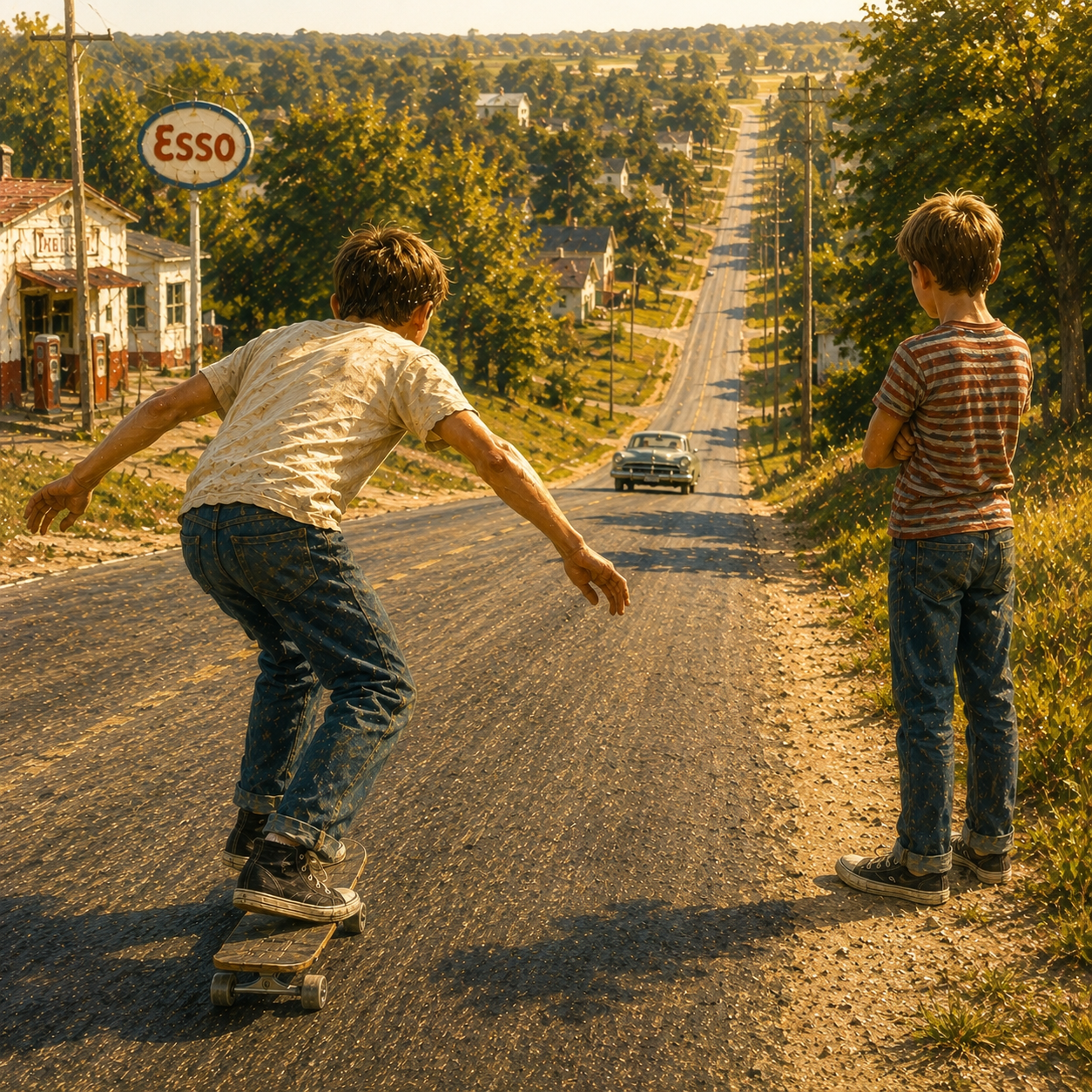
Pee Wee and Trout
The Hill
Audio Version Coming Soon
The skateboard had metal wheels and a wood deck and it had cost four dollars and forty nine cents at the hardware store in town. Trout’s mother said he would end up dead or in the hospital. His father bought it anyway. He had been born in 1912 and had done things on horses and farm equipment that would have scared anyone with the sense to be scared and he saw no reason a boy shouldn’t have a skateboard.
Trout had owned it for six days.
Pee Wee was waiting at the top of the hill. That was the system they had worked out. One goes. The other waits. Then you trade. It was Trout’s skateboard so Trout went first on the good hills. This was understood without being said.
The hill on Miller Road was longer than the one behind the Esso station and steeper than the one past the Hendersons’ and there had never been a car on it the whole summer. It went down straight and long and flattened out at the bottom near the drainage ditch and if you were going fast enough when it flattened you could feel it in your stomach.
Trout set the board down.
Pee Wee stood with his arms crossed and said nothing because there was nothing to say. This was the hill. They had been looking at it for two weeks.
Trout put his foot on the board.
Halfway down he knew it was too fast. The metal wheels on the blacktop made a sound like something tearing and the wind came up hard against his face and the board shook underneath him in a way it hadn’t on the smaller hills. He crouched lower the way he’d seen in his head when he planned it.
The board went faster.
He saw the car when he came around the long bend. It was moving slow the way cars moved on Miller Road, no reason to hurry, just a woman going somewhere on a Sunday. She saw him the same moment he saw her and she pulled toward the center.
Trout looked at the gravel on the left side of the road. He looked at the ditch. He looked at the car.
The last thought he had was that this was going to hurt.
He went left.
Pee Wee saw it from the top of the hill. He saw Trout go left and he saw the gravel and he saw what happened when the metal wheels hit it and then Trout was not on the board anymore and the board was in the ditch and Pee Wee was already running.
He was big for nine and he ran the way big kids run, heavy and fast, his boots loud on the blacktop all the way down the hill.
Trout was beside the road.
There was a lot of blood. More than Pee Wee had a category for. It was coming from Trout’s face which was wrong in a way Pee Wee did not look at directly. The woman from the car was standing in the road with her hand over her mouth.
Pee Wee looked at Trout once more to make sure he was breathing. He was.
Pee Wee turned and ran for town.
He ran the whole way without stopping. His lungs hurt by the Henderson mailbox and he kept going. Past the Esso station. Past the three houses on the curve. All the way to the store.
He hit the door hard enough to rattle the glass.
Carol’s father was already on the porch. The woman from the car had come in the other way. She had gotten there first. She had told him there was a boy beside the road covered in blood and he had already sent someone for Trout’s parents and was pulling his truck keys from his pocket with his thumb.
He had one hand. Lost the fingers in a corn picker when he was not much older than Pee Wee. He used the thumb the way other men used a whole hand, efficiently, without thinking about it.
He looked at Pee Wee.
“I know,” he said. “Get in.”
Trout woke up in the hospital. His eyes were swollen shut. He knew he was in the hospital because of the smell and because his mother was holding his hand and not saying anything which was how he knew it was serious. His nose felt wrong. His mouth felt wrong. His face felt like something that had happened to someone else.
He could hear his father’s voice somewhere in the room talking to another man. He could hear Pee Wee breathing near the window. Pee Wee breathed loud when he’d been running.
“Pee Wee,” Trout said.
It came out wrong because of his mouth but it came out.
“Yeah,” Pee Wee said.
Trout couldn’t see anything. His face hurt in colors.
“Did you go down the hill,” he said.
A long pause.
“It’s your skateboard,” Pee Wee said.
Trout’s mother made a sound that was not quite a laugh and not quite the other thing. Carol’s father said something to Trout’s father in a low voice. Trout heard his father make the short sound he made when he agreed with something.
The skateboard was still in the ditch on Miller Road.
Nobody went back for it that day.
By suppertime every house in town knew.
Trout couldn’t see for two days because of the swelling. When it went down enough he could make out the window and the ceiling and the shape of his mother in the chair beside the bed.
His father came in on the second morning and stood at the foot of the bed for a while.
“Your mother was right,” he said.
“I know,” Trout said.
His father nodded once.
“Good hill though,” he said.
He left before Trout could answer.
Pee Wee came every day. He didn’t say much. He sat in the chair by the window and looked out at the parking lot and occasionally reported what was happening in town which was not much because it was never much. The Hendersons’ dog had gotten into something. The Esso station got a new sign. Carol had asked about Trout twice which Pee Wee reported without additional comment.
On the fourth day Trout asked about the skateboard.
“Still in the ditch,” Pee Wee said.
“Wheels okay?”
Pee Wee looked at him for a moment.
“Probably,” he said.
Outside the window the heat sat on the parking lot the way it had been sitting on everything all summer. A car pulled in slowly and parked and a man got out and stood in it for a moment before going inside.
It was still a good summer.
Just not that week.
.