Pee Wee and Trout
Watery
Audio Version Coming Soon
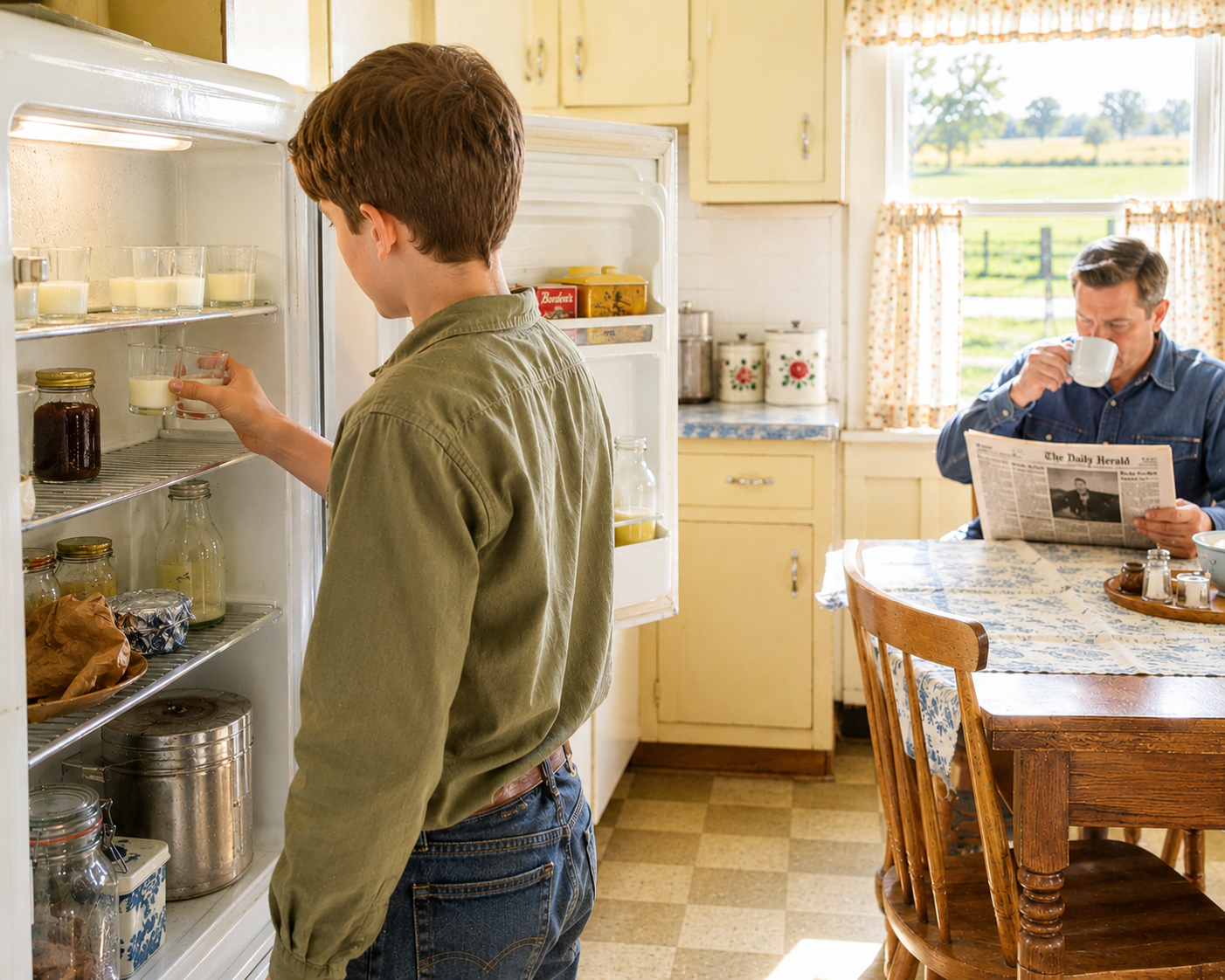
Trout’s family did not throw food out. This was not a rule that got explained. It was just the operational reality of the kitchen, inherited from people who had lived through years when throwing food out meant something different than it meant now, and it ran through every cabinet and every shelf and especially through the refrigerator which at any given time held four or five small glasses of things waiting to be used.
Milk mostly.
Two sips left in a glass from breakfast. Three sips from supper. Half a glass from the night before that. You didn’t pour them out. You put them in the fridge and in the morning someone put them in their coffee or their tea and that was the system and it had been the system since before Trout was born and would be the system long after and nobody looked twice at a small glass of something in the refrigerator because small glasses of something were just part of the landscape in there.
This was important later.
Kristie lived outside. That was how country dogs lived. She had a dog house his father had built from an aluminum shower stall he’d gotten somewhere, fitted out with a wooden floor and old blankets, and his father was proud of that ingenuity in the specific way he was proud of solutions that used what was available instead of what was obvious. Kristie seemed fine with it. She was a German shepherd, serious and loyal and trusted completely, and she spent her days doing what country dogs did which was ranging the property and sleeping in the sun and being exactly where she was supposed to be when you needed her.
When she had her litter they brought her into the basement to keep the puppies warm. Trout was there for puppies two through four. He had just missed the first one but he could see her circling and he knew what was happening and he crawled into the space with her and stayed. She was completely fine with this. She had known Trout his whole life and he had known her and there was an understanding between them that didn’t require negotiation.
The puppies came out in long dark fluid balloons which Kristie bit open carefully, each one, and if a puppy couldn’t find a teat Trout put it on one. He did this with the same operational seriousness he brought to the mouse trap line and the meteor search and every other thing that required attention and procedure. It was important work and he knew it and Kristie knew it and the puppies did not know anything yet but were warm and that was sufficient.
A few days later Trout noticed the milk. You could see it. Dripping off the teats in small steady drops between feedings, more than the puppies were taking, just present and available the way things on a dairy farm were present and available because that was what this country did, it produced milk, and Kristie was producing it the same as anything else.
Trout looked at the milk. He looked at the basement stairs. He thought about the refrigerator at the top of those stairs and the small glasses that lived in it without investigation.
The plan assembled itself the way good plans did, quickly and with internal logic, each piece finding its place without being forced.
He went and got a small glass.
Kristie allowed it. She was feeding puppies and she was full and she trusted Trout completely and she held still while he worked with the focused competence of a boy who had grown up in dairy country and understood the basic mechanics of the situation. He got half a glass.
He looked at it.
It was thin. Thinner than cow’s milk. More blue-white than yellow-white.
He took it upstairs and put it in the refrigerator next to the other small glasses. It fit perfectly. It looked exactly right.
He went to find Pee Wee.
Pee Wee listened to the whole thing at the fence. The puppies. The milk. The glass. The refrigerator. The system his family had for small glasses of things.
He didn’t say anything for a moment.
Then he said: “Genius.”
This was the complete extent of the peer review.
Trout’s father came in from outside the next morning and went to the refrigerator the way he went to the refrigerator, directly and without ceremony, and looked at what was available. He found the small glass. He poured it into his tea. He stirred it once and drank it while he read the paper and looked out the window at the morning coming up over the back field.
Trout sat at the kitchen table and ate his cereal. He waited for the sequence to complete. His father drank his tea. He turned a page. He drank some more.
Trout put his spoon down.
“How’s your tea,” he said.
His father looked up from the paper.
“Fine,” he said. “Why.”
“Just wondering,” Trout said. “How it tastes.”
His father looked at him with the expression he used when he was deciding how much of something was worth pursuing.
“Fine,” he said again. “Little watery maybe.”
He went back to the paper.
Trout looked at the glass.
“That’s Kristie’s milk,” he said.
His father put the paper down. He looked at Trout. He looked at the glass. He looked at Trout again. He opened his mouth once and closed it. Then he just sat there for a moment with the specific expression of a man who has applied his full lifetime of practical experience to a situation and found that his lifetime of practical experience did not contain this exact situation and he was not certain what category it belonged in.
“Well,” he said finally.
He looked at the glass one more time.
“It was a little watery,” he said.
He picked up the paper.
He told Trout’s mother that evening. She was appalled. She used that word specifically. She was a teacher and well-read and she had a precise vocabulary for situations that warranted it and this was a situation that warranted appalled and she applied it fully. She said there were things that lived in dog’s milk. Organisms. Things that could pass from a dog to a person through the milk and take up residence and cause problems that a person might not even know about until considerably later.
She looked at Trout’s father.
Trout’s father considered this information.
“Tasted fine,” he said. “Little watery.”
His mother made the sound she made when she had more to say and had decided not to say it.
Trout told Pee Wee the next morning at the fence. All of it. The tea. The paper. The expression. Little watery. His mother’s full deployment of appalled.
Pee Wee listened without interrupting.
When it was done he was quiet for a moment.
“Worms,” he said.
“Apparently not,” Trout said.
Pee Wee nodded slowly.
“Still genius,” he said.
Kristie was in the basement with her puppies. The puppies were fat and warm and had no idea any of this had happened. The small glass was out of the refrigerator now. The other small glasses remained. Waiting, as they always waited, patient and unremarkable, for whoever came to the refrigerator next and needed something for their coffee or their tea and didn’t look too closely at what was available.
The system continued. As it always had. As it always would.
.